The primary mirror is the Newtonian reflector's main light-collecting optical component. The 600 mm parabolic mirror is made from SCHOTT SUPREMAX 33 and optically figured by AstroReflect. The completed optic has been verified interferometrically and was subsequently coated by ZAOT S.r.l. with its high-reflectivity SAP-EH coating.
The 600 mm primary mirror installed in the telescope mirror cell.
At a glance
Nominal diameter
600 mm
Thickness
38 mm
Focal length
2,991 mm
Focal ratio
f/5
Figure
Parabolic
Mirror substrate
SCHOTT SUPREMAX 33
Linear coefficient of thermal expansion
3.25 × 10⁻⁶ K⁻¹ (20–300 °C)
Optical figuring
AstroReflect
Strehl ratio
0.978
RMS wavefront error
0.024 λ at 550 nm
Coating
ZAOT S.r.l. – SAP-EH
Reflectance
Approximately 95% at 500–600 nm; average ≥89% at 400–700 nm
Substrate
Mirror material
The mirror is made from SCHOTT SUPREMAX 33, a borosilicate glass of type 3.3. Its low thermal expansion makes the material well suited to precision optics where dimensional stability under changing temperature is important.
SCHOTT specifies a linear coefficient of thermal expansion of 3.25 × 10⁻⁶ K⁻¹ over 20–300 °C. The material has a density of 2.23 g/cm³ and a thermal conductivity of 1.2 W/(m·K).
Figuring
Optical figuring and verification
The mirror blank was optically figured to a parabolic surface by AstroReflect. The finished mirror was subsequently verified interferometrically.
The measurement report gives a radius of curvature of 5,982.0 mm and a focal ratio of f/5. The measured best-fit conic constant is −1.008, compared with −1.000 for an ideal paraboloid. The report gives a Strehl ratio of 0.978 and an RMS wavefront error of 0.024 λ at 550 nm.
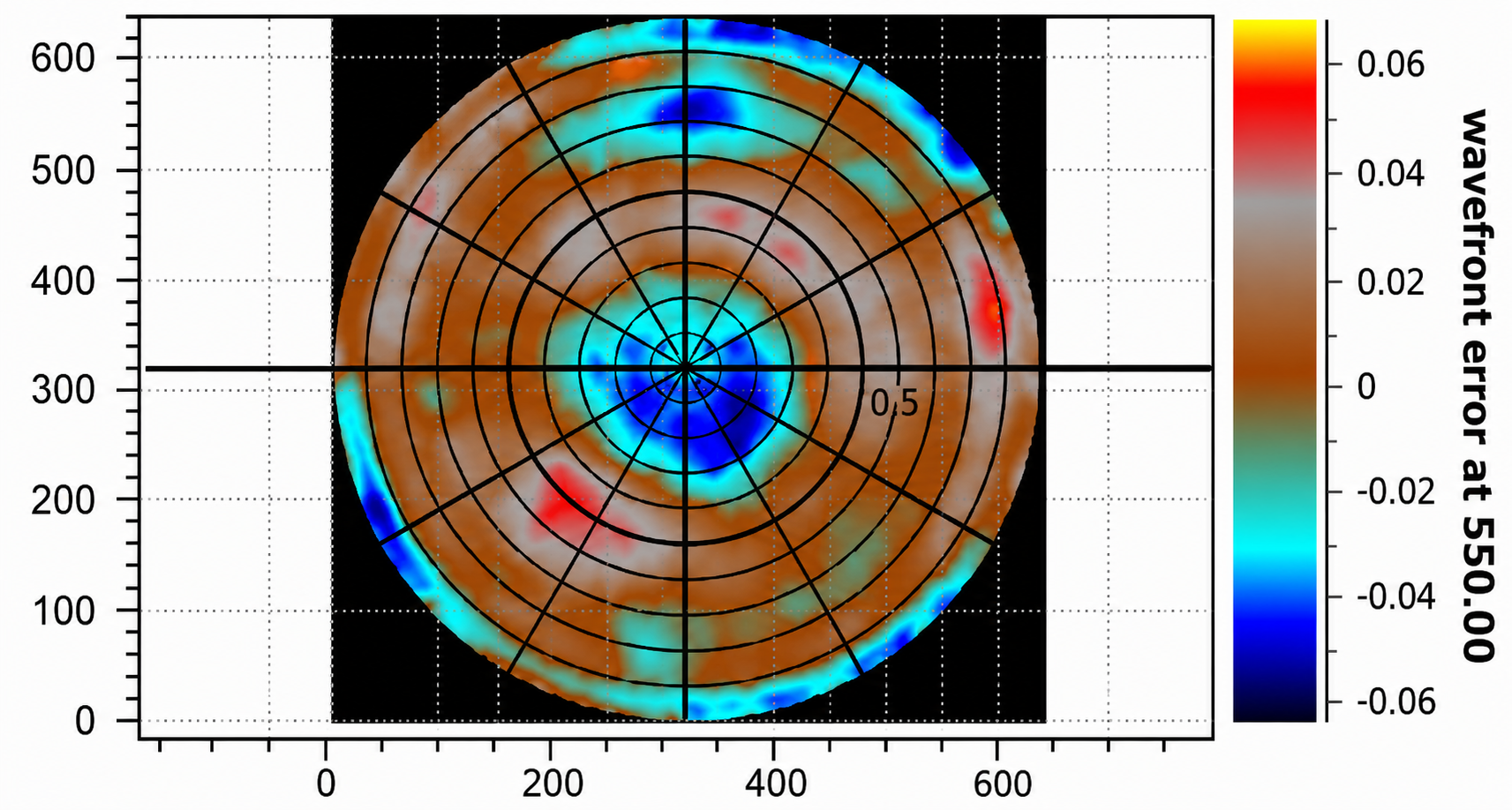
Interferometric wavefront map. The map shows how the measured wavefront differs from the ideal parabolic wavefront that the primary mirror is intended to produce. The colour scale gives the deviation in fractions of a wavelength at 550 nm, approximately the middle of the visible spectrum. The scale extends roughly from −0.06 λ to +0.06 λ. At 550 nm, 0.06 λ corresponds to about 33 nm of wavefront deviation, or 33 millionths of a millimetre.
Interferometric wavefront map of the primary mirror. The colours show small local deviations from the ideal parabolic wavefront at 550 nm.
Areas near the zero level correspond to very little deviation from the ideal figure, while colours towards either end of the scale show small positive or negative deviations. The colours therefore indicate both the magnitude and direction of the deviation.
The colours should not be interpreted as visible irregularities in the mirror surface. They represent very small optical deviations in the reflected wavefront. The map therefore shows both where across the aperture the deviations occur and their magnitude relative to the ideal optical figure.
Most of the measured aperture lies close to the ideal figure, with only local variations. The overall optical quality is summarised by an RMS wavefront error of 0.024 λ at 550 nm and a Strehl ratio of 0.978. Together, these values show that the primary mirror's figure lies very close to the intended parabolic figure and that the remaining wavefront deviations are small.
Surface
Reflective coating
After optical figuring, the primary mirror was coated by ZAOT S.r.l. with the company's SAP-EH coating, a high-reflectivity coating for astronomical optics.
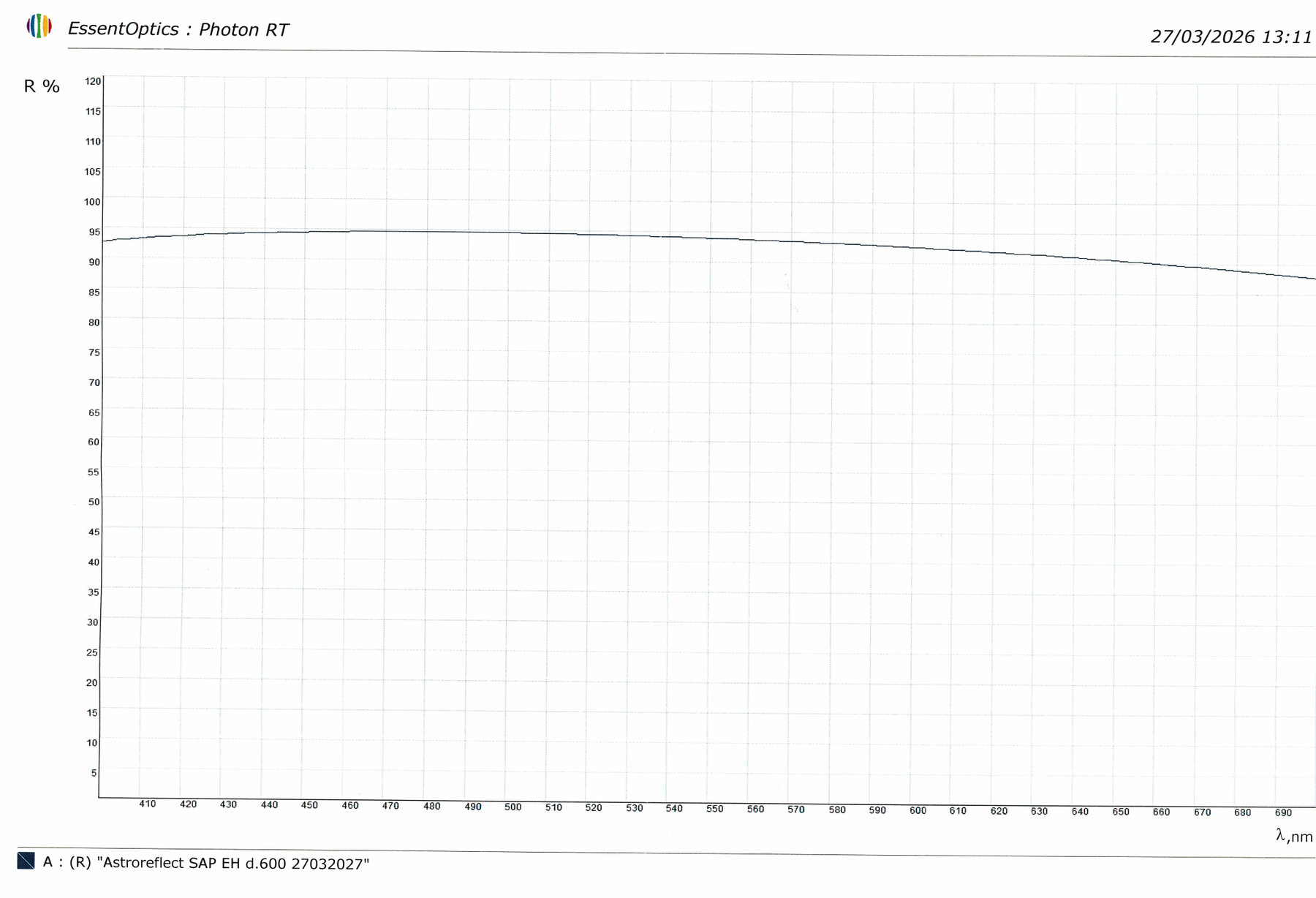
Measured reflectance is around 95% across much of the most relevant visual range, with approximately 95% at 500–600 nm and an average reflectance of at least 89% over 400–700 nm.
Measured reflectance of the SAP-EH coating across the visual wavelength range.